
Midjourney
The AI image generator with the strongest aesthetic, period
Overview
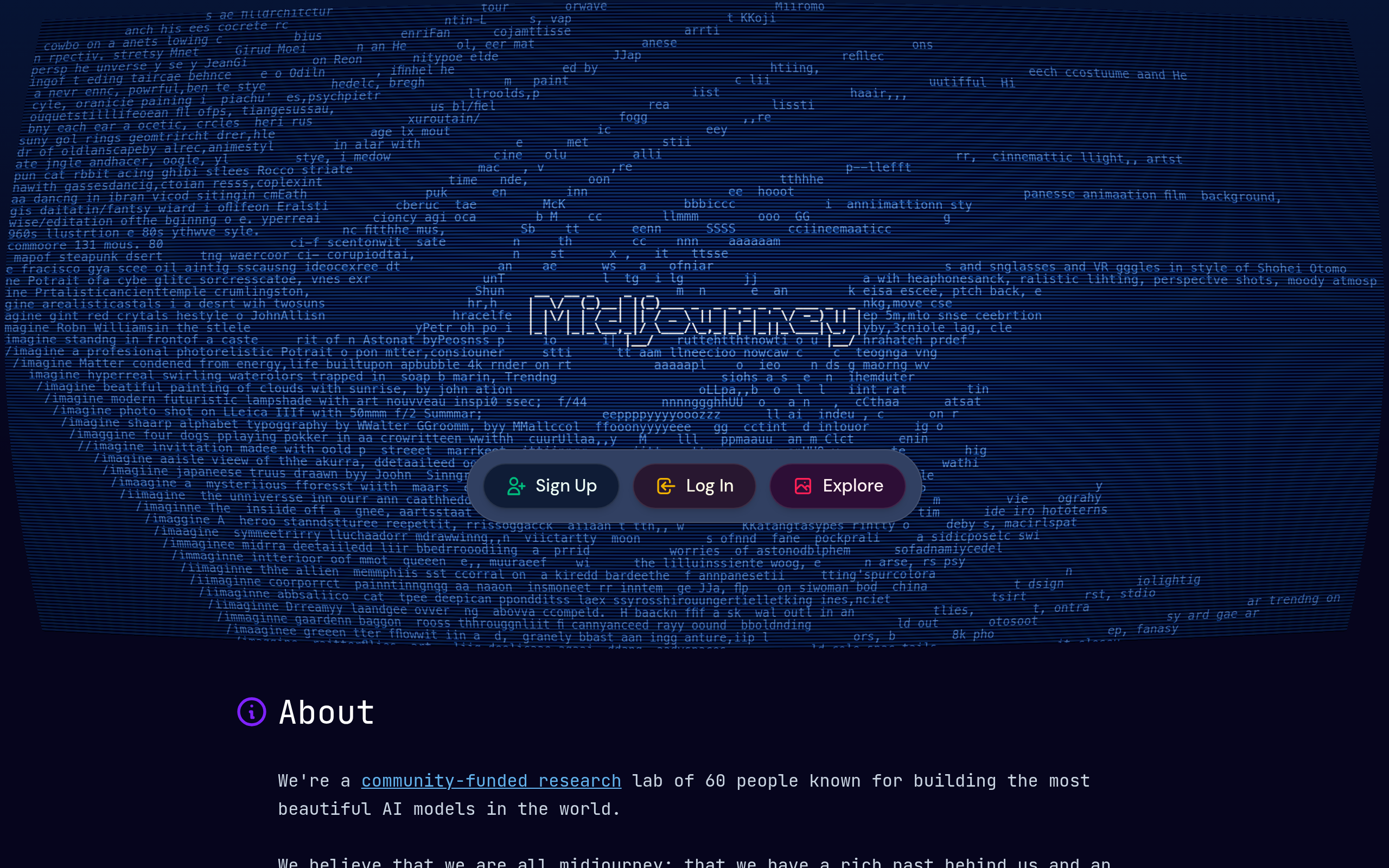
Midjourney is still the AI image generator with the strongest aesthetic out of the box, four years into the category. Where DALL·E and Flux compete on flexibility and prompt accuracy, Midjourney optimizes ruthlessly for one thing: images that look beautiful without requiring prompt-engineering expertise. That's why it remains the default for marketers, brand designers, and creative directors who need ad creative, social content, blog hero images, and pitch deck visuals — not technical illustration.
Pricing starts at $10/month for Basic (about 200 images), $30/month for Standard (unlimited slow generations), and $60/month for Pro (concurrent jobs and stealth mode). The platform moved off Discord in 2024 with a proper web interface, which finally made it accessible to non-technical marketers. The trade-off vs.
Ideogram is text rendering: Midjourney still struggles to put readable text inside images, while Ideogram nails it. The trade-off vs. Flux and Stable Diffusion is openness: those let you fine-tune on your own brand assets, while Midjourney is a closed model.
For marketers who want beautiful images fast without becoming an AI expert, Midjourney is the right default.
Key features
- Highest aesthetic quality for marketing and brand creative
- Web interface (replaced Discord-only access in 2024)
- Style references (--sref) for consistent brand visual style
- Character references for keeping the same person across images
- Vary Region (inpainting) for selective edits
- Unlimited slow-mode generations on Standard and Pro tiers
Pros
- Unmatched out-of-the-box aesthetic quality compared to DALL·E, Flux, or Ideogram
- Style references make brand-consistent image series genuinely easy
- Web UI is finally usable for non-Discord users
- Pricing is a fraction of Adobe Firefly or hiring stock photography
Cons
- Text rendering inside images is noticeably worse than Ideogram
- Closed model — no fine-tuning on your own brand assets like Flux or Stable Diffusion allow
- No native API for programmatic generation (community wrappers exist but are unstable)
Best for
Marketers, brand designers, and creative directors who need ad creative, social content, and hero images that look beautiful without spending hours on prompt engineering.
Frequently asked questions
Is Midjourney worth $10/month for a solo marketer?+
Yes — at $10/month for ~200 images, Midjourney pays for itself the first time you use it instead of buying stock photos. Most active users land on the $30/month Standard tier for unlimited slow generations.
How does Midjourney compare to DALL·E in ChatGPT?+
Midjourney produces noticeably more aesthetic, magazine-quality images. DALL·E (via ChatGPT Plus) is better at following exact prompts and rendering text. For brand and marketing creative, Midjourney is the stronger choice. For quick illustrations and text-in-image, DALL·E is faster.
Does Midjourney have an API?+
Not officially. Several third-party API wrappers exist but are unreliable and violate Midjourney's TOS. If programmatic generation is critical, use Flux, Ideogram, or Replicate instead.
Can Midjourney generate images with my brand colors and style?+
Sort of — style references (--sref) let you anchor a generation to the visual style of an existing image, which is the closest thing to brand consistency. True fine-tuning on a custom brand dataset isn't possible (Flux or Stable Diffusion are better choices for that).
Is Midjourney good for ad creative?+
Yes — many performance marketing teams use Midjourney for the static ad creative pipeline because the aesthetic quality outperforms Adobe stock at a fraction of the cost. Pair it with AdCreative.ai or Pencil for ad-specific layouts.
Alternatives to Midjourney
Where Midjourney shows up in our playbooks
The playbooks and posts on this site that recommend, compare, or walk through how to use Midjourney.
The AI Marketing Glossary — 30+ Terms Every Marketer Should Know
A no-fluff glossary of the AI and AEO terms reshaping marketing in 2026 — explained in plain English with concrete examples.
The Best AI Marketing Tools in 2026
A no-fluff guide to the AI tools real marketers actually use in 2026 — categorized by job, with honest pricing and specific use cases.
How to Build an AI Marketing Stack That Compounds
A step-by-step playbook for assembling an AI marketing stack that gets more valuable over time — instead of becoming a $1,000/month tool graveyard.
Related tools

AdCreative.ai
AI ad creative generation built for performance marketing teams

Ideogram
The AI image generator that actually gets text right
Arcads
AI UGC video ads — type a script, get a real-looking UGC creator video
Get one playbook a week.
Real tactics for marketers using AI. No fluff, no spam.